
Mount Kailash Tour for Jains
The Mount Kailash Tour for Jains is one of the most spiritually charged pilgrimages available anywhere on earth. While the mountain is globally recognized as the abode of Lord Shiva, its significance in Jain cosmology runs equally deep. For Jain devotees, Mount Kailash is Ashtapada, the sacred peak where Lord Rishabhdev (Adinath), the first of the 24 Tirthankaras, attained moksha, final liberation from the cycle of birth and death.
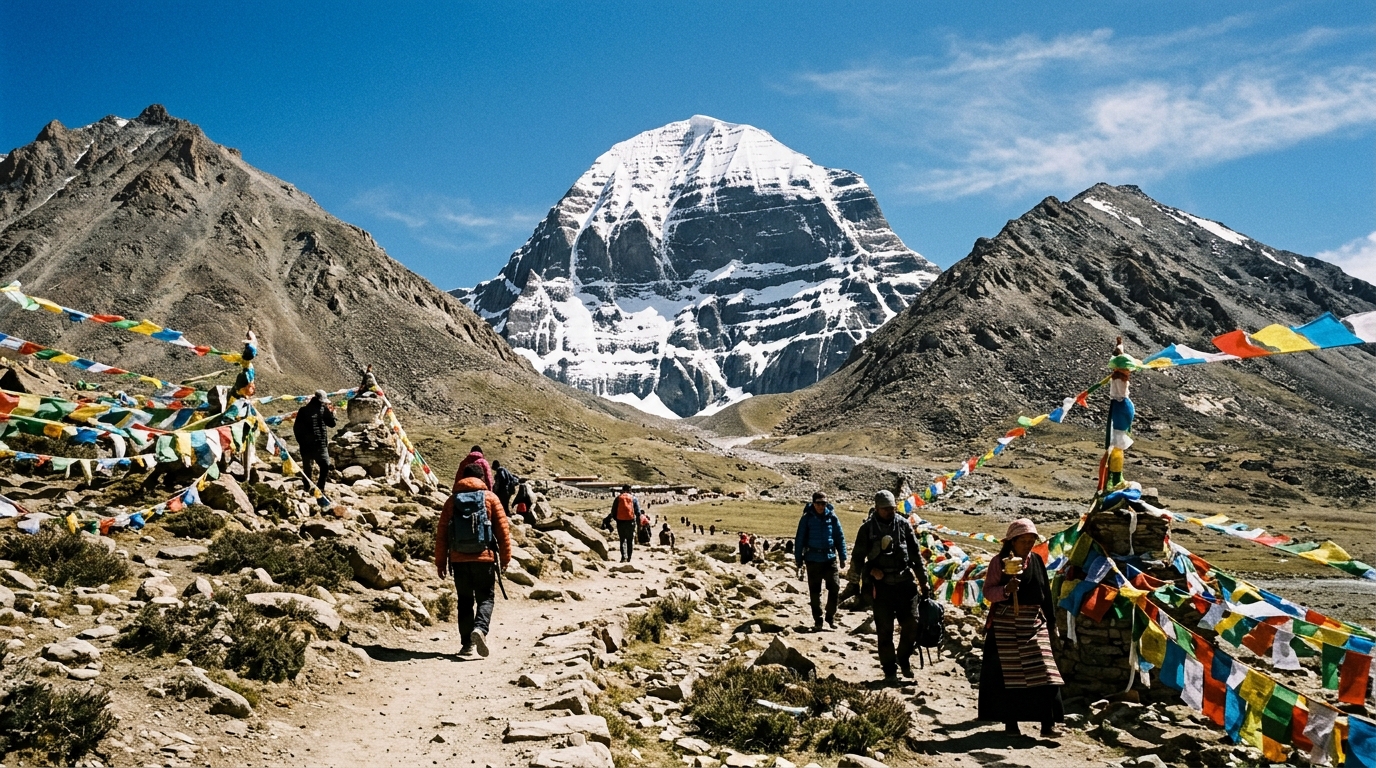
This is not a standard sightseeing tour. It is a yatra that walks pilgrims across some of the most remote and spiritually potent terrain on the planet: the high Tibetan plateau, the shores of Lake Mansarovar at 4,590 meters, and the 52-kilometer Kailash Kora circuit that crosses the Dolma La Pass at 5,630 meters. Every stage of the journey connects directly to Jain principles of non-violence, self-purification, and the relentless pursuit of liberation.
Mount Kailash Trip has been organizing Kailash Mansarovar yatras for Jain pilgrims from India and abroad, with full Tibet permit processing, Jain-sattvik vegetarian meals, expert guides, and customized group itineraries. Whether you are traveling as an individual devotee, a family, or an organized Jain group from a temple or association, we build the tour around your specific needs.
Why Mount Kailash is Sacred for Jains: The Ashtapada Connection
In Jain cosmology, Mount Kailash is identified as Ashtapada, the eight-stepped celestial mountain described in texts including the Jambudvipa Prajnapti and the Adipurana. The name Ashtapada refers to the eight ascendant levels of spiritual achievement, and the mountain is held as the place where Lord Rishabhdev (also known as Adinath), the first Tirthankara, attained final liberation.
Jain scripture records that after Rishabhdev’s moksha, his son King Bharata built a magnificent temple on the slopes of Ashtapada to honor his father and the other Tirthankaras. This temple complex, described in detail in Jain texts, made the mountain an eternal symbol of liberation and Jain dharma. Though the temple no longer stands in physical form, the spiritual significance of the site remains absolute.
For devout Jains, visiting Ashtapada (Mount Kailash) is therefore not simply pilgrimage tourism. It is a direct communion with the site of the highest spiritual achievement in Jain history, a place where the veil between the material and the liberated is believed to be thinnest.
Key Jain facts about Mount Kailash (Ashtapada):
- Identified in Jain scripture as the site of Lord Rishabhdev’s moksha
- King Bharata built a Tirthankara temple on its slopes, as described in the Adipurana
- The name Ashtapada refers to the eight stages of spiritual ascent in Jain philosophy
- Venerated as a site of liberation by both Digambara and Shvetambara Jain traditions
- The mountain’s four faces align with the four cardinal directions, significant in Jain cosmological geography
Who Can Join the Mount Kailash Yatra for Jains?
The Kailash Mansarovar yatra for Jain devotees is open to Indian and international Jain pilgrims who are physically capable of high-altitude travel and trekking. There are no restrictions based on Jain sect (Digambara or Shvetambara), gender, or age, though the high altitude and physical demands of the Kora require genuine preparation.
Mount Kailash Trip organizes tours for:
- Individual Jain pilgrims joining a group departure
- Jain families seeking a private or semi-private yatra
- Jain temple organizations planning group pilgrimages with dedicated spiritual facilitation
- Jain associations and religious bodies requiring customized itineraries, acharya accompaniment, or puja arrangements
- Senior Jain pilgrims who need a slower pace, additional medical support, or helicopter assistance
For groups requiring acharyas, sadhus, or Jain scholars to accompany and lead spiritual discourse during the yatra, we can coordinate these arrangements in advance. Our private Kailash trip option is ideal for temple organizations seeking full itinerary control.
How to Reach Mount Kailash: Route Options for Jain Pilgrims
There are three principal routes to reach Mount Kailash. Each has different trade-offs in terms of travel time, cost, physical demand, and acclimatization. All routes are covered by Mount Kailash Trip with full logistics, permit support, and Jain-friendly catering.
Route 1: Overland via Kerung (Nepal-Tibet Border)
The most popular and cost-effective route. Departs Kathmandu by road to the Kerung border crossing, then through the Tibetan plateau via Saga to Lake Mansarovar and Mount Kailash. The gradual elevation gain gives good acclimatization. Total drive time from Kathmandu to Kailash is approximately 4 to 5 days each way. This is the route most Jain group tours use. See the Mount Kailash Overland Tour for full details.
Route 2: Helicopter Route via Simikot and Hilsa
Designed for pilgrims short on time or with physical limitations. Fly from Kathmandu to Nepalgunj, then helicopter to Simikot and Hilsa on the Nepal-Tibet border. From Hilsa, an overland vehicle takes you through Tibet to Mansarovar and Kailash. This route significantly reduces road travel time and is popular with senior Jain pilgrims and those who prefer a faster approach. See the Mount Kailash Helicopter Tour.
Route 3: Fly into Lhasa (Tibet Capital)
Pilgrims fly directly into Lhasa, Tibet’s capital at 3,650 meters, and spend 2 to 3 days acclimatizing while visiting Tibetan monasteries and heritage sites. The tour then drives westward through Shigatse and Saga to Mansarovar and Kailash. This is the longest route but provides the best acclimatization and the richest Tibetan cultural experience. See the Kailash Tour via Lhasa for itinerary details.
What Does the Mount Kailash Pilgrimage Package for Jains Include?
All Mount Kailash Trip packages for Jain pilgrims are built with specific attention to Jain dietary ethics, spiritual observances, and group requirements.
Standard inclusions across all Jain pilgrimage packages:
- Chinese group visa and Tibet Travel Permit processing
- All local transportation in Nepal and Tibet
- Accommodation (hotels, guesthouses, and camps as per route)
- Jain-sattvik vegetarian meals throughout (no root vegetables, onion, or garlic)
- English-speaking and Hindi-speaking guides
- Sherpa guides and porters for the Kailash Kora
- Emergency oxygen cylinders and basic first aid throughout
- Group spiritual activities including puja, bhakti kirtan, and prabhat feri
Specialized Jain group departures can also include:
- Satsang sessions and Jain religious discourse led by accompanying acharyas or scholars
- Bhav-yatra rituals and group puja at Mansarovar and Kailash base
- Maun vrat support and designated silence periods during the Kora
- Jain thali meal arrangements and paryushan or chaturmas timing alignment
Mount Kailash Tour Cost for Jain Pilgrims
Pricing varies based on route, group size, travel season, and accommodation level. The table below gives current approximate ranges. Contact us for exact pricing for your group.
Permits and Documentation for Jain Pilgrims
Visiting Mount Kailash requires crossing into the Tibet Autonomous Region of China, which involves several permits and documentation requirements. Mount Kailash Trip handles all of this as part of the tour package.
- Chinese Group Visa: All foreign nationals including Indian citizens must obtain a Chinese group visa. Individual tourist visas for Tibet are not issued; travelers must join a group of at least 5 people.
- Tibet Travel Permit (TTP): Issued by the Tibet Tourism Bureau, required for entry into Tibet. Arranged by your tour operator.
- Alien Travel Permit (ATP): Required for travel to restricted areas including Mount Kailash and Lake Mansarovar.
- Military Area Permit: Required for entry into specific border areas near Kailash.
- Passport validity: Minimum 6 months validity required at time of travel.
We manage the complete permit application process once you confirm your booking. Read more about permit requirements in our guide: Required Permits for Mount Kailash Trip by Route.
Physical Requirements and Kora Difficulty for Jain Pilgrims
The spiritual call is strong, but the physical demands of the Kailash Mansarovar yatra are real and should be respected. Here is what Jain pilgrims need to know.
The Kailash Kora: 52 km over 3 Days
The Kora is the sacred circumambulation of Mount Kailash. It covers approximately 52 kilometers over 3 days, with the central challenge being the crossing of Dolma La Pass at 5,630 meters. At this altitude, the air contains roughly half the oxygen available at sea level. Altitude sickness is a genuine risk for anyone who has not acclimatized properly.
Preparation Timeline
Jain pilgrims should begin physical preparation at least 2 to 3 months before departure:
- Daily walking, starting from 30 minutes and building to 90-minute uphill walks
- Light cardio (cycling, swimming, or jogging) to build cardiovascular endurance
- Yoga and pranayama to improve breathing efficiency at altitude
- Avoid smoking and heavy alcohol consumption in the months prior
- Consult your physician about Diamox (acetazolamide) for altitude acclimatization
Support Options During the Kora
Horses and porters are available for hire at Darchen, the starting point of the Kora. Senior pilgrims or those with limited mobility can complete a partial Kora or choose the Charan Sparsh Tour, which includes a meaningful approach to the base of the mountain without requiring the full 3-day circuit. For more on fitness and difficulty, read: Mount Kailash Kora Distance and Difficulty.
Best Time for the Mount Kailash Tour for Jains
The Tibet Autonomous Region has a short travel window. The road and border crossings are accessible only during certain months, and weather conditions play a major role in the safety and quality of the experience.
- May to June: Good conditions, moderate temperatures. The landscape is at its most colorful. Avoid late June due to early monsoon effects in Nepal.
- July to early August: The most risky window due to monsoon rains in Nepal causing landslides on the Kerung route. Travel possible but unpredictable.
- September to October: The best months overall. Clear skies, stable roads, excellent visibility of the mountain. Many Jain groups choose this window.
- March and April: Tibet is closed to foreign tourists during these months due to administrative restrictions.
Many Jain pilgrimage groups deliberately time the yatra to align with Paryushan (August/September) or Chaturmas (the Jain monsoon retreat), when the spiritual context adds additional meaning to the journey. The Saga Dawa Festival Tour in May/June is also popular, as the festival draws pilgrims from all traditions and creates a powerful communal spiritual atmosphere at Kailash.
For full seasonal guidance, read: Kailash Trip Planning for 2026.
Spiritual Activities During the Mount Kailash Jain Yatra
Beyond the physical journey, the yatra is structured to create genuine spiritual depth at each stage.
- Darshan of all four faces of Mount Kailash – north, south, east, and west – each associated with different Jain cosmological significance
- Holy bath in Lake Mansarovar at 4,590 meters, believed in both Jain and Hindu tradition to dissolve accumulated karma
- Prayers and meditation at Yam Dwar, the symbolic gateway between the mortal and liberated realms
- Contemplative walking during the Kora with focused reflection on ahimsa (non-violence) and aparigraha (non-attachment)
- Jain bhakti songs and group devotional chanting at designated points along the route
- Optional Charan Sparsh – the steep ascent to the base of Kailash, available as an extension for those physically prepared
- Satsang and Jain dharma discourse at campsites during the Kora, facilitated by accompanying scholars or acharyas
- Sunrise and sunset meditation at Mansarovar’s shore, one of the most profoundly quiet places on earth
Jain Ethical Considerations and Dietary Arrangements
Traveling in Tibet presents real logistical challenges for Jain pilgrims adhering to strict dietary principles. Mount Kailash Trip addresses this directly and comprehensively.
Food and Diet
All meals provided throughout the yatra are Jain-sattvik vegetarian: no root vegetables (potatoes, carrots, radishes, beets, onions, garlic). Meals are prepared in dedicated vegetarian kitchens where available. In remote camp settings, our kitchen team brings the necessary ingredients to ensure compliance. Fasting meal options and fruit-only alternatives for days of vrat or maun are available on request.
Non-Violence and the Tibetan Environment
Jain principles of ahimsa align naturally with respectful travel in Tibet. Our tours emphasize minimal environmental impact: no unnecessary disturbance of wildlife, no littering, and engagement with local Tibetan communities grounded in mutual respect. Many Jain groups observe silence (maun vrat) during portions of the Kora as an active spiritual practice.
Purity and Ritual Observance
We accommodate requests for ritual purity requirements including clean utensils, specific food preparation methods, and separate cooking for strictly observant Jain pilgrims. These arrangements must be specified at the time of booking.
Why Book Your Jain Kailash Yatra with Mount Kailash Trip?
Organizing a Kailash Mansarovar yatra requires expertise that goes well beyond standard tourism. Tibet permits, high-altitude logistics, border crossing procedures, and the specific needs of Jain groups all require experience that only comes from doing this repeatedly.
- Specialized Jain tour experience: We have organized Kailash yatras specifically for Jain groups, understanding the dietary, ritual, and spiritual requirements that are non-negotiable
- Full permit processing: Chinese group visa, Tibet Travel Permit, Alien Travel Permit, and Military Area Permit are all handled as part of the package
- 24/7 support: Our team is reachable around the clock during the yatra via WhatsApp and phone
- Registered and associated: Nepal Government registered, Nepal Tourism Board affiliated, TAAN member
- Emergency preparedness: Oxygen cylinders, first aid kits, and evacuation protocols on all trips
- Flexible customization: Private groups, fixed departures, customized itineraries, and special arrangements for acharya accompaniment
For senior Jain pilgrims, we recommend reviewing our Mount Kailash Trip for Seniors, which has a slower pace, additional medical support, and can be combined with the helicopter approach. For information on visa requirements, read: Do You Need a Visa for Mount Kailash Trip?
The Mount Kailash Yatra for Jains: A Step Toward Liberation
The Kailash Mansarovar yatra for Jains is ultimately an inward journey. The physical altitude, the immense silence of the Tibetan plateau, the freezing morning air at Dolma La, the mirror-still waters of Mansarovar at dawn – these are not incidental features of the trip. They are the environment in which the yatra is meant to work on the pilgrim.
Ashtapada is where Rishabhdev shed the final karmic bonds and stepped into liberation. Walking the same mountain, even if only its outer circuit, is an act of remembrance, aspiration, and devotion that no indoor ritual or textual study can replicate. It is the Jain dharma made physical and geographical.
Whether you come as a once-in-a-lifetime devotee, an annual yatri, or a Jain organization creating a transformative experience for your members, Mount Kailash Trip is your trusted operator for this sacred journey.
Plan Your Mount Kailash Jain Yatra
Send us your group details, preferred dates, and any specific requirements. We will respond within 24 hours with a full itinerary and pricing.
Recent Posts
Mount Kailash Kora Distance and Difficulty

Where Is Mount Kailash Located?
Common Visa Mistakes for Mount Kailash Trip
Kailash Yatra Permit Processing Time from Kathmandu
Required Permits for Mount Kailash Trip by Route
Do You Need a Visa for Mount Kailash Trip
Visa for Mount Kailash Trip
Age Limit for Mount Kailash Yatra
Mindful Trip to Mount Kailash