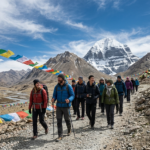

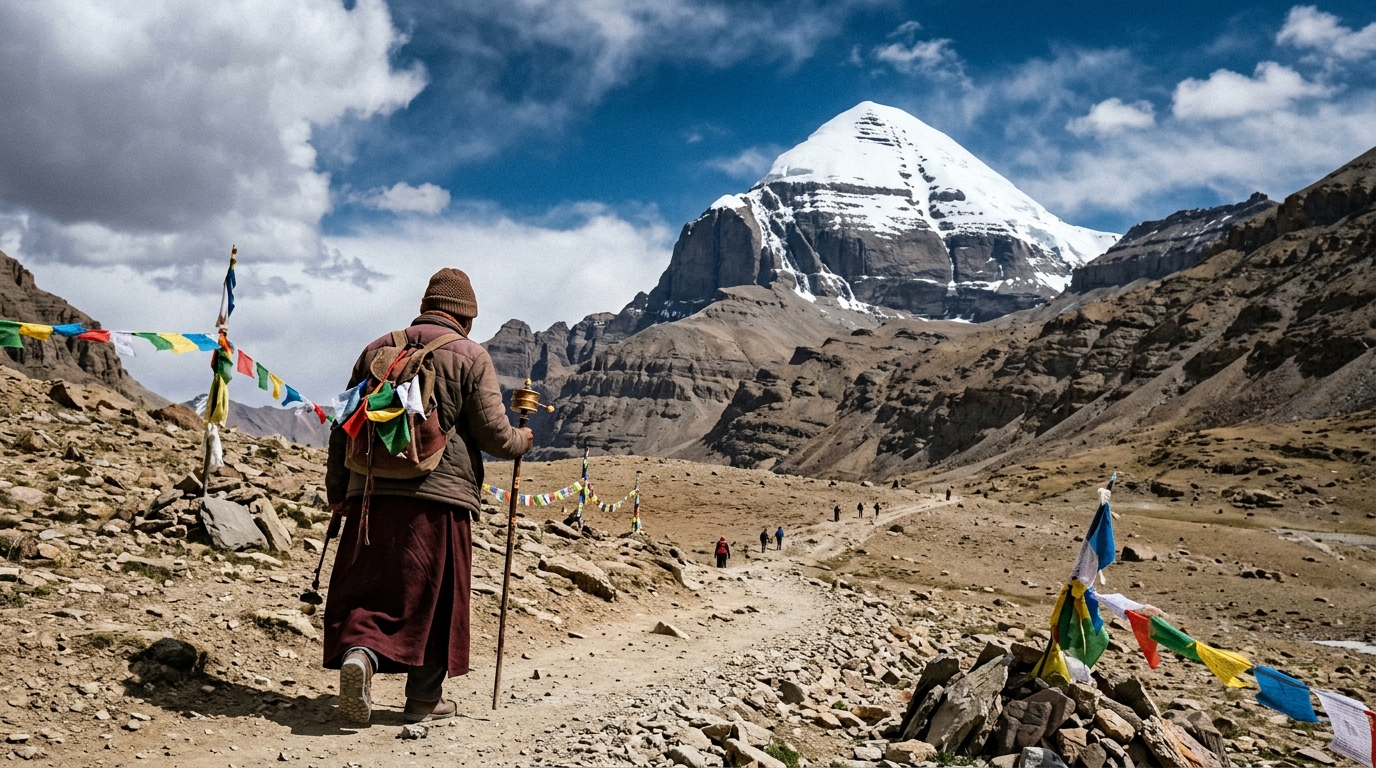
Mount Kailash Kora Distance and Difficulty
The Mount Kailash Kora also called the Kailash Parikrama, is one of the most profound pilgrimages on earth. Every year, thousands of pilgrims, trekkers, and spiritual seekers walk clockwise around this sacred mountain in western Tibet, at altitudes most people never reach in their lifetime.
The two most important questions anyone planning this journey needs answered are simple:
• How far is the Kailash Kora?
• How difficult is it?
This guide answers both in full with a day-by-day breakdown of distance, altitude, and what to expect on the trail. It also covers the Inner Kora (the shorter, more extreme circuit most guides ignore), the key sacred sites on each route, and a practical preparation checklist so you arrive ready.
Quick Reference: Kailash Kora at a Glance
| Total distance (Outer) | 52 km (32 miles) |
| Duration | 3 days |
| Altitude range | 4,675m (Darchen) to 5,630m (Dolma La Pass) |
| Difficulty | Moderate to strenuous — Day 2 is the hardest |
| Starting point | Darchen (4,675m), base town for the Kailash Yatra |
| Inner Kora distance | 34 km — single day, extreme difficulty (5,860m) |
| Inner Kora 2026 status | Only first 4.5 km open (to Selung Monastery). Full inner route restricted. |
| Best seasons | May–June and September–October |
| Horse/yak support | Available for luggage and for those who cannot walk sections |
Elevation Profile — What the Altitude Actually Looks Like
Understanding the altitude is more important than understanding the distance. The numbers below are what your body will be dealing with.
| Location | Altitude | Notes |
| Darchen (Start / End) | 4,675m | Base town. Already high — acclimatize here before starting. |
| Yamadwar (Gate of Death) | 4,750m | Traditional start of walking Kora. First 7 km often covered by vehicle. |
| Tarboche Prayer Flagpole | 4,800m | Sacred pole replaced every Saga Dawa festival. Day 1 landmark. |
| Dirapuk Monastery | 5,080m | End of Day 1. Overnight camp. North face views of Kailash. |
| Dolma La Pass | 5,630m | HIGHEST POINT. Day 2 peak. Steep 550m gain from camp. |
| Gauri Kund (Parvati Lake) | 5,608m | Sacred glacial lake just below Dolma La. Descent begins here. |
| Zutulpuk Monastery | 4,790m | End of Day 2. Overnight camp. |
| Darchen (Return) | 4,675m | End of Day 3. Gentle descent via open valley. |
Mount Kailash Outer Kora — Day-by-Day Route
Day 1: Darchen to Dirapuk Monastery
| Distance: 20 km | Walking: 6–7 hrs | Max altitude: 5,080m | Difficulty: Moderate |
The Kora begins at Darchen, but many groups cover the first 7 km to Yamadwar — the Gate of Death — by vehicle. On foot from Darchen, the full Day 1 distance is approximately 20 km. From Yamadwar, the walking is 13 km.
The route: Wide valley floor with gradual elevation gain. Dirt paths and compacted earth, gentle enough to allow your body to acclimatize. The north face of Mount Kailash appears as you round the valley and dominates the sky for the rest of Day 1. You pass Tarboche — the great prayer flagpole replaced every Saga Dawa festival — and the Chortens Kangnyi twin stupas before arriving at Dirapuk Monastery.
Sacred sites on Day 1: Yamadwar (the symbolic gate into the sacred zone), Tarboche flagpole (where sins are believed to fall away), Chortens Kangnyi twin stupas, and the Dirapuk Monastery shrine with its direct view of Kailash’s north face — one of the most powerful viewpoints on the entire circuit.
>Difficulty insight: Most people find Day 1 manageable if properly acclimatised. Cold winds and thin air are the main challenge, not terrain. Walk slowly. Do not push the pace on Day 1 — the goal is to arrive at Dirapuk in good shape for Day 2.
Practical tip: If you have spent fewer than 3 days acclimatizing in Darchen or Saga before starting the Kora, Day 1 will feel harder than it looks on paper. Altitude affects everyone differently and there is no shame in going slowly.
Day 2: Dirapuk to Zutulpuk via Dolma La Pass
| Distance: 22 km | Walking: 9–12 hrs | Max altitude: 5,630m | Difficulty: Strenuous |
Day 2 is the hardest day. It is also the most important. Everything in the Kailash Yatra leads to and comes from this day.
The route: Depart Dirapuk before 7:00 AM — earlier in winter months. The first 6 km climbs steadily through rocky moraine terrain to the base of Dolma La. The final 3 km to the pass is steep and exposed, gaining 550m over loose rock and occasional snow. Dolma La Pass sits at 5,630m — roughly 100m higher than Everest Base Camp. Above it is a stone with prayer flags marking the highest point of the Kora.
Dolma La Pass: In Tibetan Buddhism, crossing Dolma La is a symbolic death and rebirth — the passage from your old self into your new one. The prayer flags, khataks, and personal offerings left here by pilgrims cover every surface. Most people experience some combination of breathlessness, emotion, and quiet awe. Allow 20–30 minutes at the top before beginning the descent.
The descent: From the pass, the path drops steeply toward Gauri Kund — the sacred glacial lake of Parvati, sitting at 5,608m. The descent is 600m over loose rock and, in spring or early season, icy patches. Trekking poles are essential. After Gauri Kund the gradient eases and the valley opens toward Zutulpuk Monastery.
Altitude sickness warning: If you develop severe headache, loss of coordination, confusion, or cannot walk a straight line on Day 2 — stop immediately and descend. Do not continue to the pass if these symptoms appear. Your guide has emergency procedures. Diamox taken the night before Day 2 significantly reduces risk for most trekkers.
Start time matters: Leaving Dirapuk after 9 AM on Day 2 means arriving at Dolma La when afternoon weather closes in — cold, wind, and sometimes snow. Always start Day 2 at or before 7:00 AM.
Day 3: Zutulpuk to Darchen
| Distance: 14 km | Walking: 3–4 hrs | Max altitude: 4,800m | Difficulty: Easy |
After Day 2, Day 3 feels like a gift. The terrain is gentle, the altitude drops steadily, and the valley opens into wide grassland. Most pilgrims complete the return to Darchen before noon.
The route: From Zutulpuk, the path follows the valley floor south-east back to Darchen. The walking is easy — mostly flat or gradual downhill on a wide track. Milarepa’s cave (the cave where the Tibetan saint Milarepa is said to have meditated) is a short detour just below Zutulpuk and worth the few extra minutes.
Arriving back in Darchen, most pilgrims feel a combination of exhaustion and deep peace. The Kora is complete.
Mount Kailash Inner Kora — The Extreme Circuit
Most guides ignore the Inner Kora. This is a mistake — it is searched frequently and your competitors who cover it rank for an entirely separate set of high-intent keywords.
What it is: The Inner Kora is a 34 km circuit around the south face of Kailash — a shorter but dramatically more extreme route that climbs to 5,860m, 230m higher than the Outer Kora’s Dolma La. There are no lodges, no rescue infrastructure, and no water sources. The route includes rock scrambling with fixed ropes and is only suitable for experienced high-altitude trekkers.
2026 restriction: Due to current Chinese government regulations, the full Inner Kora is NOT open in 2026. Only the first 4.5 km from Darchen to Selung Monastery is permitted. The rest of the inner route remains closed to all visitors. This is the same restriction in place since 2023 — monitor permit updates as the season approaches.
For pilgrims interested in the Inner Kora as a future goal — Tibetan Buddhist tradition holds that you must complete 13 Outer Koras before attempting the Inner. In practice, very few foreign pilgrims attempt it even after completing multiple Outer circuits.
Outer Kora vs Inner Kora — Comparison Table
| Outer Kora | Inner Kora (2026: restricted) | |
| Distance | 52 km | 34 km |
| Duration | 3 days | 1 day (no camping) |
| Highest point | 5,630m (Dolma La) | 5,860m (Nandi Parvat area) |
| Difficulty | Moderate–strenuous | Extreme |
| Lodges available | Yes (Dirapuk, Zutulpuk) | None |
| Horse/yak support | Yes | Not available |
| Suitable for | Most healthy adults | Experienced mountaineers only |
| 2026 status | Fully open | First 4.5 km only |
Who Can Complete the Kailash Kora?
The Outer Kora is not a technically difficult trek — but altitude makes it serious. Here is an honest assessment.
Healthy adults: The Kora is achievable for most healthy adults between 20 and 70 who allow proper acclimatization time. We have guided clients in their late 60s who completed the circuit comfortably. Age is rarely the limiting factor — attitude, acclimatization, and support are.
Senior pilgrims: Possible with preparation. Yak or horse support for luggage significantly reduces the physical demand on Day 2. A slower pace adds half a day but reduces risk substantially. Our senior-specific packages build in an extra acclimatization day before the Kora begins.
First-time trekkers: No trekking experience is required for the Outer Kora. What is required is basic fitness (being able to walk 5–6 hours on flat ground) and a willingness to go slowly. Your guide sets the pace — trust them.
People with medical conditions: Consult your doctor before booking if you have heart conditions, respiratory issues, or a history of altitude sickness. The altitude at Dolma La (5,630m) is not trivial. Your guide carries a pulse oximeter — listen to the readings.
Key Tips for a Successful Kailash Kora
- Spend at least 2–3 days acclimatizing in Darchen or Saga before starting the Kora. This is not optional.
- Walk slower than you think you need to. Altitude sickness is caused by going too fast, not by going at all.
- Drink 3–4 litres of water per day. Dehydration at altitude accelerates AMS symptoms.
- Do not mix alcohol and altitude. One drink at 4,675m has the effect of three at sea level.
- Hire a yak or porter for your main pack. You only need to carry a daypack. Your body will thank you on Day 2.
- Start Day 2 by 6:30–7:00 AM. Non-negotiable. Late starters face afternoon weather on the pass.
- Tell your guide immediately if you have a headache that gets worse after resting, confusion, or difficulty walking straight. These are serious symptoms.
- Joining a guided tour with medical support is strongly recommended for first-time Kailash pilgrims.
Frequently Asked Question
What is the total Mount Kailash Kora distance?
The Outer Kora is approximately 52 km (32 miles), completed over 3 days. Day 1 covers 20 km (Darchen to Dirapuk), Day 2 covers 22 km (Dirapuk to Zutulpuk via Dolma La), and Day 3 covers 14 km (Zutulpuk back to Darchen). Note: the first 7 km to Yamadwar are sometimes covered by vehicle.
What is the highest point of the Kailash Kora?
Dolma La Pass, at 5,630 meters (18,471 feet). This is the highest point of the Outer Kora and the most physically demanding section of the entire circuit, reached on Day 2.
Can the Kailash Kora be done in 2 days?
It is not recommended. Completing the Kora in 2 days compresses Day 1 and Day 2 together, requiring you to reach Dolma La (5,630m) without an overnight acclimatization stop at Dirapuk. For most trekkers this significantly increases altitude sickness risk. Some very fit, highly acclimatized trekkers attempt it — but 3 days is the standard and the safe option.
Is a horse or yak available for the Kailash Kora?
Yes. Horses are available for hire in Darchen for the full circuit. They carry luggage and can carry trekkers who are unable to walk certain sections. Availability varies by season — your tour operator confirms this in advance. Note that horses cannot cross Dolma La Pass in heavy snowfall.
What is the difference between the Outer Kora and the Inner Kora?
The Outer Kora (52 km, 3 days) circles the base of Kailash and is accessible to most healthy adults. The Inner Kora (34 km, 1 day) follows the south face at higher altitude (up to 5,860m) and is an extreme route only suitable for experienced mountaineers. In 2026, the Inner Kora is restricted — only the first 4.5 km to Selung Monastery is open.
What is the weather like on the Kailash Kora?
Expect daytime temperatures of 5°C to 15°C in peak season (May–October), dropping to -5°C to -15°C at night. Dolma La Pass can see snow at any time of year. Wind on the pass is strong and cold regardless of season. Bring a full layering system including a down jacket and waterproof shell.
Do I need trekking experience to do the Kailash Kora?
No prior trekking experience is required for the Outer Kora. Good baseline fitness and proper acclimatization matter far more than trekking history. Many first-time trekkers complete the circuit each year with guided support.
What permits are required for the Kailash Kora?
The Kailash Kora requires multiple Tibet permits: the Tibet Travel Permit (TTP), Alien Travel Permit (ATP), Military Area Permit, and Ngari Prefecture Permit. These are arranged by your licensed tour operator — individual travelers cannot obtain them independently. Allow 2–3 weeks for permit processing from Kathmandu.
Can older citizens complete the Kailash Kora?
Yes — many pilgrims in their 60s and 70s complete the Kora each year with us. The key is taking more time for acclimatization, using yak/horse support for luggage, and going at a slower pace. Our senior-specific Kailash tour includes an extra acclimatization day and smaller group sizes for closer support.
What is Gauri Kund and where is it on the Kora?
Gauri Kund (also called Parvati Lake) is a sacred glacial lake sitting at 5,608m, just below Dolma La Pass on the descent side. In Hindu tradition it is the bathing lake of Goddess Parvati. Some devoted pilgrims take a ritual dip in its near-freezing water. It is reached on Day 2 immediately after crossing the pass.
Recent Posts
Mount Kailash Kora Distance and Difficulty
Where Is Mount Kailash Located?
Common Visa Mistakes for Mount Kailash Trip
Kailash Yatra Permit Processing Time from Kathmandu
Required Permits for Mount Kailash Trip by Route
Do You Need a Visa for Mount Kailash Trip
Visa for Mount Kailash Trip
Age Limit for Mount Kailash Yatra
Mindful Trip to Mount Kailash