
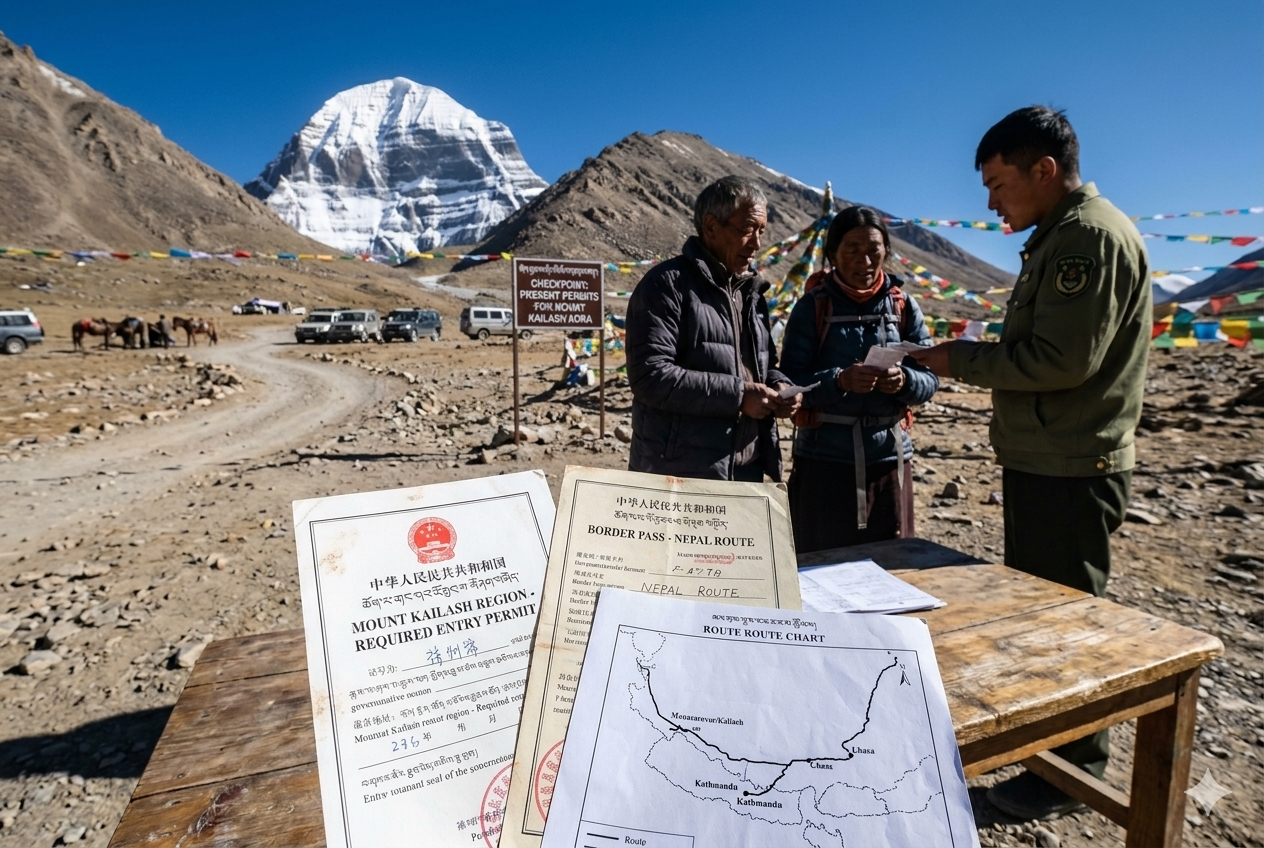
Required Permits for Mount Kailash Trip by Route
mNo one reaches Mount Kailash without a stack of permits. The mountain sits inside one of the most restricted travel zones on earth — the Tibet Autonomous Region of China and every route to reach it requires a specific combination of visa and permit documents, processed in a specific sequence, through a licensed tour operator.
What most guides get wrong is treating all permits as the same regardless of route. They are not. The Nepal overland route, the Simikot helicopter route, the Lhasa overland route, and the Indian MEA route each require a different combination of documents and getting this wrong means delays, rejections, or being turned back at a checkpoint.
This guide breaks down every permit required for every major route to Kailash in 2026 — what each document is, who issues it, how long it takes, what it costs, and what happens if you arrive without it.
Permits Required by Route — 2026 Master Comparison
| Permit | Nepal Overland | Simikot/Helicopter | Lhasa Overland | MEA India Route |
| Chinese Group Visa | ✔ | ✔ | ✘ | ✔ |
| Individual China Visa | ✘ | ✘ | ✔ | ✘ |
| Tibet Travel Permit | ✔ | ✔ | ✔ | ✔ |
| Alien Travel Permit | ✔ | ✔ | ✔ | ✔ |
| Military Area Permit | ✔ | ✔ | ✔ | ✔ |
| Ngari Prefecture Permit | ✔ | ✔ | ✔ | ✔ |
| Foreign Affairs Permit | ✘ | ✘ | ✔ | ✘ |
| Nepal RAP (Humla) | ✘ | ✔ | ✘ | ✘ |
| Nepal TIMS Card | ✘ | ✔ | ✘ | ✘ |
| Nepal Conservation Fee | ✘ | ✔ | ✘ | ✘ |
What Each Permit Is and Why You Need It
Before breaking down by route, it helps to understand what each permit actually does — because the names are confusing and many guides use them interchangeably when they are distinct documents.
| Tibet Travel Permit (TTP) |
| Issued by: Tibet Tourism Bureau (TTB), Lhasa
Processing time: 8–10 working days Approx. cost: CNY 300–500 — typically included in tour package Why you need it: The foundational document for all Tibet travel. Without it, you cannot board a train or flight to Lhasa from mainland China, or cross the Nepal-Tibet border by road. It is issued only to licensed Tibet tour operators on behalf of travellers — individual applications are not accepted. Every pilgrim on every route needs this permit first. Even Chinese citizens require a TTP to enter the TAR. |
| Alien Travel Permit (ATP) |
| Issued by: Public Security Bureau (PSB), Tibet — issued in Lhasa or Shigatse
Processing time: 1–2 hours (processed locally after arrival in Lhasa) Approx. cost: CNY 50 per person — typically included in tour package Why you need it: Required for travel outside Lhasa to restricted areas: Shigatse, Gyantse, Everest Base Camp, and critically, the Ngari region (Mount Kailash and Manasarovar Lake). Your guide applies for this at the local PSB office in Lhasa while you begin your tour. It is stamped into your passport and checked at checkpoints throughout the journey to Darchen. |
| Military Area Permit |
| Issued by: Tibet Military Command via licensed operator
Processing time: 3–5 working days (applied for pre-departure) Approx. cost: Included in tour package Why you need it: Required for all border-adjacent and military-sensitive areas in Tibet. Mount Kailash sits close to the India and Nepal borders, making the entire Ngari region a military zone. This permit is applied for by your operator before you leave Kathmandu or Lhasa and must be presented at military checkpoints along the G219 highway approaching Darchen. Without it, you will be turned back before reaching the mountain. |
| Ngari Prefecture Permit |
| Issued by: Ngari Prefecture authorities via licensed operator
Processing time: 3–5 working days (applied for pre-departure) Approx. cost: Included in tour package Why you need it: The specific permit for the Kailash and Manasarovar zone within Ngari Prefecture. This is separate from the ATP and Military Permit and is verified at checkpoints specific to the western Tibet region. Many travellers researching permits independently miss this document because older articles only list three permits. In 2026, all serious operators include this in the standard permit stack for Kailash. |
| Foreign Affairs Permit (FAP) |
| Issued by: Foreign Affairs Office, Lhasa
Processing time: 10–15 working days Approx. cost: Included in tour package where required Why you need it: Required for certain border areas, sensitive locations, and some eastern Tibet routes. For the Lhasa overland route to Kailash, the FAP is required in addition to the Military Permit due to the route’s passage through multiple politically sensitive prefectures. It is issued by the Lhasa Foreign Affairs Office and arranged by your operator. This permit is frequently omitted from incomplete permit guides — if your Lhasa-route operator has not mentioned it, ask explicitly. |
Route 1: Nepal Overland (Kathmandu → Rasuwagadhi/Gyirong → Saga → Darchen)
The most popular route for international pilgrims in 2026. The Nepal overland route crosses into Tibet at the Rasuwagadhi-Gyirong border (Nepal side: Rasuwagadhi; Tibet side: Gyirong/Kerung port of entry). From the border, the drive continues west through Saga and Paryang to reach Darchen in 5–7 days depending on acclimatization stops.
| Permit Required | Issued by | Processing |
| Chinese Group Visa | Chinese Embassy, Kathmandu | 4–6 working days |
| Tibet Travel Permit (TTP) | Tibet Tourism Bureau via operator | 8–10 working days |
| Alien Travel Permit (ATP) | PSB, Lhasa (after arrival) | 1–2 hours in Lhasa |
| Military Area Permit | Tibet Military Command via operator | 3–5 working days |
| Ngari Prefecture Permit | Ngari authorities via operator | 3–5 working days |
Key points for Nepal overland route
- Total lead time: apply at least 3–4 months before departure. TTP and Group Visa are the long poles.
- Your passport must be in Kathmandu for the Group Visa application — arrive 5–7 days before departure to submit originals to the Chinese Embassy.
- Indian nationals: Group Visa is processed through the Chinese Embassy in New Delhi, not Kathmandu. NRIs process through their country of residence.
- Nepali citizens: no Chinese Group Visa required (visa-free arrangement). Tibet permit stack still required in full.
- Border crossing point: Rasuwagadhi (Nepal side), Gyirong Port (Tibet side). Immigration and customs processed here. Carry all original permits.
- ATP is the only permit processed after arrival — your guide applies for it in Lhasa within the first 1–2 hours. It does not delay the start of your tour.
Route 2: Simikot / Helicopter Route (Nepalgunj → Simikot → Hilsa → Purang → Darchen)
The Simikot route flies from Kathmandu to Nepalgunj, then to Simikot in far-western Nepal, followed by a trek or helicopter to the Hilsa border crossing into Tibet. It is faster than the overland route but requires an additional set of Nepal-side trekking permits before the Tibet border is reached.
| Permit Required | Issued by | Processing |
| Chinese Group Visa | Chinese Embassy, Kathmandu | 4–6 working days |
| Tibet Travel Permit (TTP) | Tibet Tourism Bureau via operator | 8–10 working days |
| Alien Travel Permit (ATP) | PSB, Purang or local (after border) | 1–2 hours |
| Military Area Permit | Tibet Military Command via operator | 3–5 working days |
| Ngari Prefecture Permit | Ngari authorities via operator | 3–5 working days |
Key points for Simikot route
- Nepal-side permits are applied for in Kathmandu before your domestic flight to Nepalgunj. Your operator handles all three simultaneously.
- Total permit stack: 8 documents (5 Tibet + 3 Nepal). This is the most permit-intensive route.
- Border crossing point: Hilsa (Nepal side) — the Sino-Nepal border at approximately 3,640m. Helicopter transfers from Simikot to Hilsa are weather-dependent and can be delayed 1–2 days.
- The Tibet checkpoint at Hilsa-Purang verifies your Group Visa, TTP, Military Permit, and Ngari Permit on entry.
- Despite having more permits, the Simikot route has more flexible scheduling and is often preferred by pilgrims with limited time who want to skip the long overland drive from Gyirong.
Route 3: China Mainland / Lhasa Overland (Beijing or Chengdu → Lhasa → Saga → Darchen)
This route enters China first via a standard individual Chinese tourist visa, then travels to Lhasa by flight or train before heading west overland to Kailash. It is the most culturally immersive approach, often including Lhasa, Gyantse, Shigatse, and Everest Base Camp. It is also the route with the most permits.
| Permit Required | Issued by | Processing |
| Individual Chinese Tourist Visa | Chinese Embassy in home country | 5–10 working days |
| Tibet Travel Permit (TTP) | Tibet Tourism Bureau via operator | 8–10 working days |
| Alien Travel Permit (ATP) | PSB, Lhasa (after arrival) | 1–2 hours in Lhasa |
| Military Area Permit | Tibet Military Command via operator | 3–5 working days |
| Ngari Prefecture Permit | Ngari authorities via operator | 3–5 working days |
| Foreign Affairs Permit (FAP) | Foreign Affairs Office, Lhasa | 10–15 working days |
Key points for Lhasa route
- Total lead time: 3–4 months minimum. The FAP has the longest processing time of any permit on this route.
- Unlike the Nepal route, the individual Chinese tourist visa is applied for through your home country Chinese Embassy — not through a Nepal-based operator.
- Tibet is NOT covered by China’s 144-hour transit visa-free programme. If you enter via Chengdu or Lhasa, you need a full Chinese tourist visa plus the Tibet permit stack.
- Some nationalities face additional restrictions on the Lhasa route. Check current visa eligibility with the Chinese Embassy in your country.
- The TTP for the Lhasa route is sent by your Tibet operator (usually China-based) to your accommodation in Lhasa or collected on arrival — different process from the Nepal route where it is distributed by your Kathmandu operator before departure.
- This route typically adds 5–8 days to the total trip vs the Nepal overland route due to Lhasa cultural days and the longer drive west.
Which Route Requires the Fewest Permits?
If permit simplicity is a deciding factor for you, here is the honest comparison:
| Route | Total Permit Documents | Longest Processing Step | Complexity |
| Nepal Overland | 5 documents | TTP — 8–10 days | Low — all from Kathmandu |
| Simikot / Helicopter | 8 documents (5+3 Nepal) | TTP — 8–10 days | Medium — extra Nepal permits |
| Lhasa Overland | 6 documents | FAP — 10–15 days | High — most permits, longest lead time |
| MEA India Route | 4 (govt-handled) | Full MEA process — months | Low for pilgrim (govt does it), very competitive |
For most international pilgrims, the Nepal overland route offers the best balance: fewest documents, all processed from one city (Kathmandu), and the most experienced operator network. The Simikot route has more permits but faster total travel time. The Lhasa route has the most permits and the highest complexity but the richest cultural experience.
Documents You Need to Provide to Your Operator
Regardless of route, your operator needs the following from you to begin the permit process. Missing any of these delays the entire application.
| Document | Requirements |
| Passport scan (colour) | All data pages. Must be valid for 6+ months beyond your travel end date. Must have blank pages for stamps. |
| Passport photographs | White background. Typically 4–6 copies. Your operator specifies exact dimensions for the embassy. |
| Completed application forms | Provided by your operator. Every field must match your passport exactly — name spelling, date of birth, nationality. |
| Medical certificate | Required for all pilgrims aged 60+. Required for Indian nationals on all routes. Must confirm fitness for altitudes above 4,500m from a registered MBBS doctor. |
| PAN card (Indian nationals) | Required for Indian citizens for the permit dossier. Not required for Nepali or foreign nationals. |
| Travel insurance | Strongly recommended — must cover high-altitude trekking and helicopter evacuation. Operator may require proof for 65+ pilgrims. |
| Undertaking / indemnity forms | Provided by your operator. Signed confirmation that you understand the altitude risks and physical demands of the journey. |
Frequently Asked Questions
How many permits do I need for the Kailash trip?
It depends on your route. The Nepal overland route requires 5 documents: Chinese Group Visa, Tibet Travel Permit, Alien Travel Permit, Military Area Permit, and Ngari Prefecture Permit. The Simikot route requires those 5 plus 3 Nepal-side permits (RAP, TIMS, Conservation Area Permit) — 8 total. The Lhasa overland route requires an individual Chinese tourist visa plus 5 Tibet permits including the Foreign Affairs Permit — 6 total. The MEA India route has 4 permits, all handled by the government agency.
Do all routes to Kailash need the same permits?
No. The core Tibet permit stack (TTP, ATP, Military Permit, Ngari Permit) is required on all routes. What changes is the entry visa: Nepal and Simikot routes need a Chinese Group Visa; the Lhasa route needs an individual Chinese tourist visa; the MEA route uses a special group visa arranged by the Indian government. The Simikot route additionally requires three Nepal-side trekking permits. The Lhasa route additionally requires the Foreign Affairs Permit.
Can I use my existing China visa for the Kailash trip via Nepal?
No. If you are entering Tibet via Nepal, you need a Chinese Group Visa — a completely separate document from a standard individual Chinese tourist visa. Even if you already have a valid Chinese tourist visa in your passport, you cannot use it to enter Tibet from Nepal. Your Kathmandu-based operator applies for the Group Visa at the Chinese Embassy in Kathmandu.
Do Nepali citizens need a Chinese visa for Kailash?
No. Nepal has a visa-free arrangement with China, so Nepali citizens can enter Tibet without a Chinese Group Visa or tourist visa. But you still need the full Tibet permit stack — Tibet Travel Permit, Alien Travel Permit, Military Area Permit, and Ngari Prefecture Permit. Your licensed Nepal-based operator arranges all of these for you.
Is the Ngari Prefecture Permit the same as the Military Permit?
No — these are two separate documents. The Tibet Military Command issues the Military Area Permit, which covers all border-sensitive zones across Tibet, including Ngari. The Ngari Prefecture authorities issue the Ngari Prefecture Permit specifically for the Kailash and Manasarovar area. You need both. Your operator applies for both before you leave — but confirm this explicitly when you book.
What is the Foreign Affairs Permit and who needs it?
The Lhasa Foreign Affairs Office issues the Foreign Affairs Permit (FAP) for border areas and politically sensitive zones in Tibet. If you travel to Kailash via the Lhasa overland route, you need this permit because the journey passes through several sensitive prefectures. The Nepal overland and Simikot routes generally do not require it. Allow 10–15 working days for processing — it takes longer than any other permit on the Lhasa route.
Can I apply for Tibet permits myself without a tour operator?
No. The Tibet Tourism Bureau only issues the Tibet Travel Permit to licensed tour operators — individual applications are not possible. This is a fixed regulatory rule, not something operators invented. The same applies to all other Tibet permits: ATP, Military, Ngari, and FAP. Every Kailash trip must go through a registered, TTB-licensed agency. There is no workaround.
What happens if I arrive at the border without the correct permits?
Border officials turn you away. At Rasuwagadhi/Gyirong (Nepal route) and Hilsa (Simikot route), Chinese immigration checks your Group Visa, TTP, Military Permit, and Ngari Permit on arrival. One missing document and you cannot cross. Military checkpoints along the G219 highway to Darchen check your permits again. You cannot get missing permits at the border — there is no on-the-spot solution.
How far in advance should I apply for permits?
Nepal overland route: start 3–4 months before departure. Lhasa route: start 4–5 months before — the Foreign Affairs Permit takes 10–15 working days and you can only apply for it after the TTP comes through. MEA India route: apply the moment the registration window opens in February–April. The single most common reason Kailash Yatra plans fall apart is leaving the permit process too late.
Are permits included in the tour package price?
With most reputable operators, yes. The Tibet Travel Permit, Alien Travel Permit, Military Area Permit, Ngari Prefecture Permit, and Foreign Affairs Permit (where your route requires it) are typically included in your package. The Chinese Group Visa fee (CNY 400–600) may be separate or bundled depending on your operator. For the Simikot route, the Nepal-side permits — RAP, TIMS card, and Conservation Area fee — are usually included too. Always ask your operator to confirm exactly what is and is not covered before you pay.
The Right Permits, Route & Operator.
Mount Kailash sits in one of the world’s most politically sensitive and geographically extreme regions — and that is exactly why the permit system exists. Getting the permits right is not bureaucracy for its own sake. It is the difference between completing a once-in-a-lifetime pilgrimage and being turned back at the border.
Every route requires a different permit combination. Every permit has a different issuing authority, processing time, and purpose. The one thing that never changes: you cannot obtain any of them on your own. You need a licensed Tibet tour operator with an established relationship with the Tibet Tourism Bureau and the relevant Chinese authorities.
Our team has been processing Kailash permits from Kathmandu for over two decades. We know the current processing windows, the checkpoint requirements, and the seasonal shifts that affect approval speed. Share your travel dates with us and we will tell you exactly which permits you need, in what order, and how long the whole process will take.
Recent Posts
Mount Kailash Kora Distance and Difficulty
Where Is Mount Kailash Located?
Common Visa Mistakes for Mount Kailash Trip
Kailash Yatra Permit Processing Time from Kathmandu
Required Permits for Mount Kailash Trip by Route
Do You Need a Visa for Mount Kailash Trip
Visa for Mount Kailash Trip
Age Limit for Mount Kailash Yatra
Mindful Trip to Mount Kailash