
Visa for Mount Kailash Trip
Complete Guide for Kailash Yatra Travelers
Mount Kailash sits inside the Tibet Autonomous Region of China, one of the most restricted travel zones on earth. Getting there is not a matter of booking a flight and packing a bag. Every pilgrim, regardless of nationality, needs a specific combination of visa and permits before a single border crossing can happen.
The good news: once you have a licensed tour operator, the process is managed for you. The important thing is to understand what is required, when to start, and why each document exists so you can plan with confidence and avoid the most common and costly mistakes.
Complete Permit & Visa Stack
| Document | Issued by | Processing time |
| Chinese Group Visa | Chinese Embassy (Kathmandu for Nepal route; New Delhi for Indian residents) | 4–6 working days |
| Tibet Travel Permit (TTP) | Tibet Tourism Bureau (TTB) via operator | 8–10 working days |
| Alien Travel Permit (ATP) | Public Security Bureau (PSB), Lhasa | 1–2 hours (processed in Lhasa) |
| Military Area Permit | Tibet Military Command via operator | 3–5 working days |
| Ngari Prefecture Permit | Ngari Prefecture authorities via operator | 3–5 working days |
| Nepal Tourist Visa (foreigners only) | Nepal Immigration, Kathmandu airport | On arrival |
Key fact: The Ngari Prefecture Permit is the document most often overlooked by travellers researching independently. Without it, you will be turned back at checkpoints before reaching Darchen. It is always included in your package when booking through a licensed operator but confirm this explicitly.
What Each Document Is and Why You Need It
Chinese Group Visa
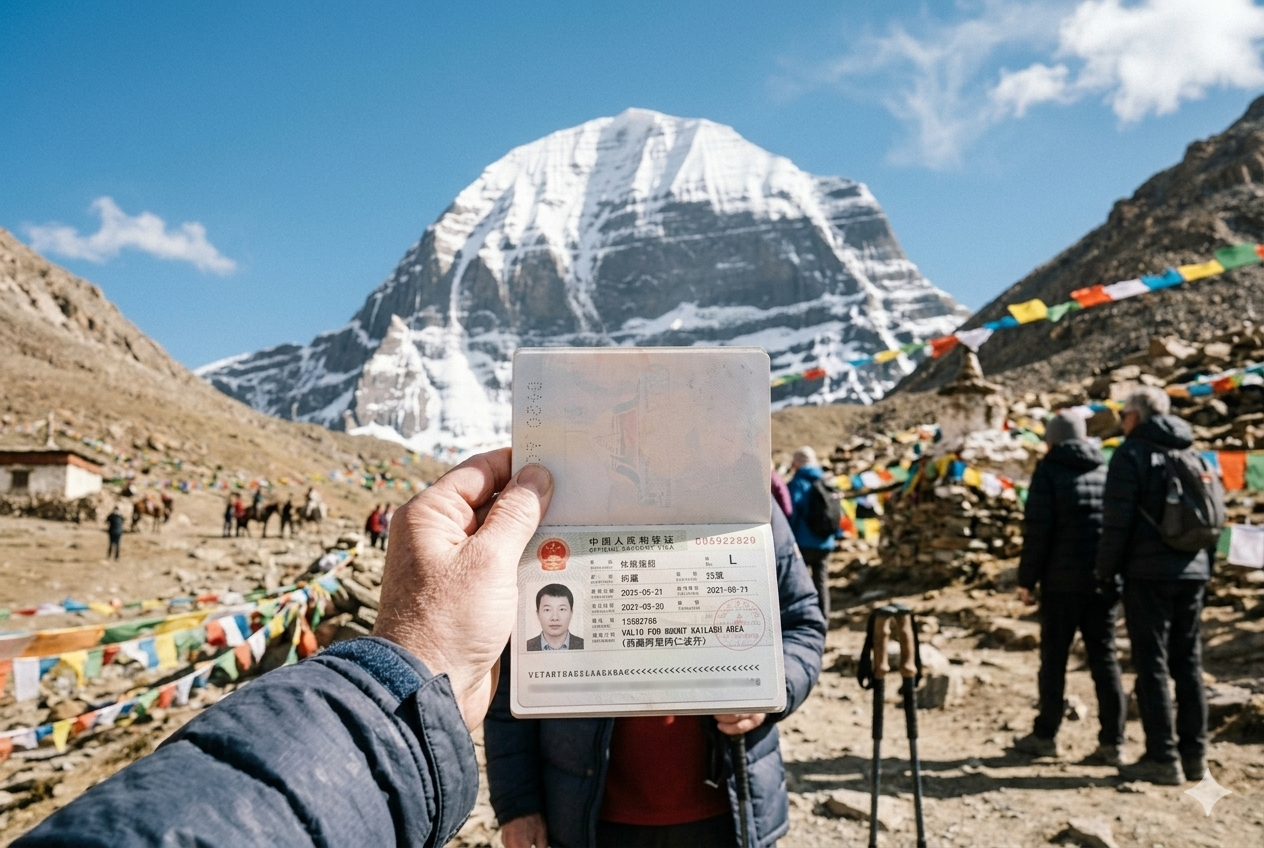
The Chinese Group Visa is the primary entry document for visiting Tibet via Nepal. It is fundamentally different from a standard individual China tourist visa in two ways: it is issued as a group document covering all members of your tour, and it is valid only for the specific itinerary tied to your permit stack. You cannot use it to visit other parts of China.
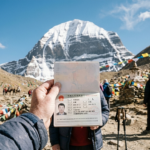
The visa is a paper document (not a sticker in your passport) issued by the Chinese Embassy in Kathmandu or in New Delhi for Indian residents. It covers your entry from Nepal into Tibet, travel within the Kailash region, and exit back through Nepal.
Critical warning: Do NOT write ‘Tibet,’ ‘Kailash,’ or ‘Mansarovar’ on any independent China visa application. Doing so will trigger a rejection. All applications for the Kailash region must go through your licensed operator.
Tibet Travel Permit (TTP)
The Tibet Travel Permit is the foundational document allowing entry into the Tibet Autonomous Region. It is issued by the Tibet Tourism Bureau (TTB) in Lhasa and can only be applied for by a registered Tibet tour operator on your behalf. Individual applications are not accepted — this is a structural requirement, not a bureaucratic formality.
Notably, even Chinese citizens need a Tibet Travel Permit to enter the TAR — Tibet has a separate internal travel restriction system from the rest of China. For foreign pilgrims, this permit is always the first document in the chain and gates everything else.
Processing: 8–10 working days from the time your operator submits your passport details to the TTB. This is the longest single processing step and determines your minimum lead time from booking to departure.
Alien Travel Permit (ATP)
The ATP is an additional permit required to visit restricted areas within Tibet beyond Lhasa — including Shigatse, Gyantse, Everest Base Camp, and the Ngari region. For Kailash pilgrims, it covers the driving route from Lhasa or Shigatse westward through Saga and Paryang toward Darchen.
Unlike the TTP, the ATP is processed locally by the Public Security Bureau (PSB) in Lhasa once you are already in Tibet. Your guide handles this in 1–2 hours while you are beginning your tour. The permit is stamped into your passport.
Military Area Permit
Mount Kailash sits near the borders of India and Nepal — a strategically sensitive zone. The Military Area Permit authorizes travel through designated border-adjacent regions in western Tibet. It is processed by your operator alongside the TTP before departure and takes an additional 3–5 working days.
Ngari Prefecture Permit
This is the specific permit for the Kailash and Manasarovar zone within Ngari Prefecture — the administrative district of western Tibet that includes Darchen, Manasarovar, and the entire Kora route. It is a separate document from the ATP and Military Permit, and is required at checkpoints along the G219 highway approaching Darchen.
Many travellers researching visas independently miss this permit because older articles only list three permits. In 2026, all four are required. When booking with a licensed Nepal-based operator like ours, all four are included in your package and applied for simultaneously.
Useful Reading: Age limit for Mount Kailash Yatra
How the Visa & Permit Process Works — Step by Step
Understanding the sequence helps you plan your timeline and avoid the most common booking mistakes.
| Step | What happens | |
| 1 | Book your tour | Confirm your place and departure date with a licensed Nepal-based operator. Your operator cannot apply for permits without your booking confirmed. This is the trigger for everything that follows. |
| 2 | Submit documents | Provide your operator with: original passport scan, passport-size photos (white background), completed application forms, and medical certificate if required. Indian nationals also provide PAN card. |
| 3 | TTP application | Your operator submits your details to the Tibet Tourism Bureau (TTB) in Lhasa via their licensed Tibet partner. Processing: 8–10 working days. This is the longest step. |
| 4 | Group Visa application | Once TTP is confirmed, your operator submits to the Chinese Embassy in Kathmandu (or New Delhi / country of residence for Indians). Processing: 4–6 working days. The visa is issued as a group paper document. |
| 5 | Military & Ngari permits | Applied simultaneously by your operator. Processing: 3–5 working days. Usually returned before or alongside the Group Visa. |
| 6 | Biometric registration | Indian nationals and some other nationalities attend biometric registration (fingerprinting) at the designated centre. Your operator schedules this. Required before the border crossing. |
| 7 | Depart Kathmandu | Your operator distributes all documents before departure. Carry originals at all times. Checkpoints along the route verify the TTP, Group Visa, Military Permit, and Ngari Permit. |
| 8 | ATP in Lhasa | If your route includes Lhasa, your guide applies for the Alien Travel Permit (ATP) at the local PSB office. Takes 1–2 hours. Stamped in your passport while you begin your Lhasa sightseeing. |
| 9 | Kailash Kora | With all permits in order, travel continues to Darchen and the Kora begins. Carry all permit documents for checkpoint verification throughout the route. |
Documents Required from You
Your operator handles the applications. What they need from you:
| Document | Requirements |
| Original passport (scan and later physical) | Valid for at least 6 months beyond your travel dates. Must have blank pages for stamps. |
| Passport-size photographs | White or light background. Typically 2–4 copies. Your operator specifies the exact size. |
| Completed application forms | Provided by your operator. Fill accurately — name must match passport exactly. |
| Medical certificate | Required for Indian nationals (MEA and private routes). Required for all pilgrims aged 60+. Must state fitness for altitudes above 4,500m. |
| PAN card (Indian nationals only) | Required for the permit dossier for Indian citizens in 2026. Not required for foreign nationals or Nepali citizens. |
| Travel insurance (strongly recommended) | Must cover high-altitude trekking and emergency medical evacuation. Kailash is remote — helicopter evacuation can cost USD 5,000–20,000 without cover. |
| Undertaking / indemnity forms | Your operator provides these. You confirm awareness of the altitude risks and medical limitations of the region. |
When to Apply — Planning Timeline
The most common reason Kailash Yatra plans fail is insufficient lead time. Here is the minimum realistic timeline working backward from your departure date.
| Time before departure | Action required |
| 4–3 months before | Book and confirm your tour with your operator. Begin document collection. Indian nationals: check MEA application window (typically opens February–April). |
| 3 months before | Submit all required documents to your operator. TTP application submitted to TTB. Medical certificate obtained if required. |
| 10–12 weeks before | TTP returned from TTB. Group Visa application submitted to Chinese Embassy. Military and Ngari permits applied for simultaneously. |
| 6–8 weeks before | Group Visa and permits returned. Biometric registration scheduled (Indian nationals and others as required). |
| 3–4 weeks before | All documents confirmed. Biometric registration completed. Operator distributes permit copies for your review. |
| Day before departure | Receive original permit documents from operator. Pack all originals safely in hand luggage — never in checked baggage. |
Common Mistakes That Cause Delays or Rejections
- Applying for a standard China tourist visa independently — this will not work for Kailash. The group visa is a completely separate document and process.
- Booking flights before permit confirmation — never book non-refundable flights until your Group Visa and TTP are confirmed in hand.
- Mismatched names on documents — your name on all application forms must match your passport exactly, including middle names and initials.
- Passport with less than 6 months validity — renew before applying if your passport expires within 6 months of your travel dates.
- Insufficient blank passport pages — you need at least 3–4 blank pages for stamps and the ATP.
- Underestimating processing time — the full permit stack takes 3–4 months to process safely. Last-minute applications in May for a June departure almost always fail.
- Using an unregistered operator — only Tibet Tourism Bureau-licensed operators can apply for the Tibet Travel Permit. Verify your operator’s TTB license before booking.
- Not declaring nationality correctly — Indian passport holders must follow Indian national rules even if resident abroad as NRIs.
Frequently Asked Questions
Do I need a visa to visit Mount Kailash?
Yes. All visitors to Mount Kailash regardless of nationality require a Chinese Group Visa and a Tibet Travel Permit at minimum. Nepali citizens are exempt from the Group Visa (visa-free access to China) but still need the Tibet Travel Permit and additional regional permits. No one can visit Mount Kailash independently or on a standard China tourist visa.
Can I use my existing China visa for the Kailash trip?
No. A standard individual Chinese tourist visa does not permit travel to the Tibet Autonomous Region. Kailash visits require a specific Chinese Group Visa linked to your tour itinerary and permit stack. Even if you already hold a valid standard China visa, you must obtain a separate Group Visa for Kailash. Your operator handles this.
Is Tibet Travel Permit the same as the Chinese visa?
No — they are two completely different documents. The Chinese Group Visa allows entry into China from Nepal. The Tibet Travel Permit (TTP) is a separate document issued by the Tibet Tourism Bureau that allows travel within the Tibet Autonomous Region. You need both, and they are applied for at different stages by your operator.
Do Indians need a Nepal visa for the Kailash trip?
No. Indian citizens do not require a visa to enter Nepal — it is visa-free for all Indian passport holders. Indian nationals travelling via the Nepal route arrive in Kathmandu without any visa requirement for Nepal. They do, however, require a Chinese Group Visa and the full Tibet permit stack for the Tibet portion of the journey.
Can I apply for Tibet permits myself without a tour operator?
No. The Tibet Tourism Bureau (TTB) only issues Tibet Travel Permits to licensed Tibet tour operators, not to individual travellers. There is no mechanism for individual permit applications. This is a structural regulatory requirement, not a voluntary restriction by operators. All permit applications must go through a TTB-licensed agency.
How long does it take to get the Kailash visa and permits?
The Tibet Travel Permit (TTP) takes 8–10 working days. The Chinese Group Visa takes 4–6 working days after the TTP is confirmed. Military and Ngari permits take 3–5 working days. The full permit stack, applied sequentially, takes a minimum of 3–4 weeks. However, with the full application process, document collection, and seasonal demand, starting 3–4 months before your departure date is strongly recommended.
What happens at the Nepal-Tibet border crossing?
The main border crossing for the Nepal route is at Gyirong (Rasuwa Gadhi) or Hilsa (Simikot route). Chinese immigration officials verify your Chinese Group Visa, Tibet Travel Permit, and passport at the crossing. Military checkpoints further along the route to Darchen verify the Military Area Permit and Ngari Permit. Carry all original documents in your hand luggage at all times.
Can OCI/PIO cardholders travel to Mount Kailash?
OCI and PIO cardholders are not eligible for the Indian Government’s MEA-organised Kailash Mansarovar Yatra. However, they can join private tour packages via the Nepal route, provided they hold a valid foreign passport (not Indian passport). The visa and permit requirements follow the rules of their passport nationality. Contact your operator with your specific passport details for accurate guidance.
Do I need travel insurance for the Kailash trip?
Travel insurance is not a permit requirement but it is strongly recommended. The Kailash region is remote, at extreme altitude, and has very limited emergency medical infrastructure. Helicopter evacuation from western Tibet can cost USD 5,000–20,000 without insurance. Your policy must explicitly cover high-altitude trekking (above 5,000m) and emergency medical evacuation. Standard travel insurance policies often exclude high-altitude activities unless specifically stated.
Recent Posts
Mount Kailash Kora Distance and Difficulty
Where Is Mount Kailash Located?
Common Visa Mistakes for Mount Kailash Trip
Kailash Yatra Permit Processing Time from Kathmandu
Required Permits for Mount Kailash Trip by Route
Do You Need a Visa for Mount Kailash Trip
Visa for Mount Kailash Trip
Age Limit for Mount Kailash Yatra
Mindful Trip to Mount Kailash